Understanding Cormac McCarthy (Understanding Contemporary American Literature) by Frye Steven
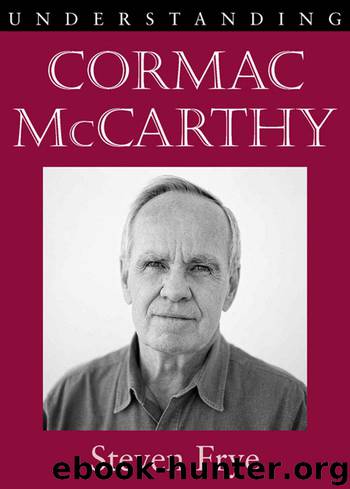
Author:Frye, Steven [Frye, Steven]
Language: eng
Format: epub
Publisher: University of South Carolina Press
Published: 2012-08-27T04:00:00+00:00
The Crossing (1994)
All the Pretty Horses propelled McCarthy into the public consciousness in a deceptively intricate rendering of the conventional western. But subsequently, The Crossing tended to confound expectations with its philosophical density and tortured religious preoccupation. In comparison to the first novel in the Border Trilogy, The Crossing initially sold quite well but sales tapered quickly, perhaps because its pacing and narrative voice appeared reminiscent of earlier works, and partly because, unlike most sequels, the novel introduces an entirely different cast of characters. The heroes of All the Pretty Horses and The Crossing would not meet until Cities of the Plain. Of course, this was the plan all along, since Cities of the Plain was the first work conceptualized in the form of a screenplay that has yet to be produced. In spite of the scant attention from the reading public, reviews of The Crossing were often quite enthusiastic, and critics seemed less perplexed with McCarthy’s abstract themes and densely philosophical influences than in the past. Those who considered the whole of McCarthy’s work in the context of The Crossing came to apprehend more fully the philosophical and religious subtexts present in his striking visual style. In the New Republic, Sven Birkerts notes that “McCarthy is writing entirely against the grain of our times, against the haste and distraction and the moral diffusion.” Birkerts observes more than previous critics that the author “has been, from the start, a writer with strong spiritual leanings.” In considering both the southern and the western works, Birkerts charts a path of thematic concern, arguing that “in the early books we heed his exacerbated awareness of violence and cruelty, of evil, without finding much place for the good. But now, in these most recent books, we meet up quite often with decency.” 17 The presence of moral order had been an aspect of McCarthy’s world since The Orchard Keeper, and it is evident in works as bleak as Child of God and Blood Meridian, but critics of All the Pretty Horses and The Crossing place greater emphasis on the redemptive possibilities that emerge from events and the interaction of characters with the world. Reviewers remained enraptured with McCarthy’s language and were still quite forthright in acknowledging his influences, but they claimed for him an individual stature distinct from those influences. In the New York Times Book Review, Robert Hass calls The Crossing “a miracle in prose” that “deserves to sit on the shelf certainly with ‘Beloved’ and ‘As I Lay Dying,’ ‘Pudd’nhead Wilson’ and ‘The Confidence-Man.’” He continues to compare McCarthy with writers as significant and varied as William Shakespeare, Samuel Beckett, Miguel de Cervantes, Joseph Conrad, and Ernest Hemingway. For Hass, McCarthy also warrants comparison to filmmakers like John Ford, Sam Peckinpah, and Sergio Leone, as well as Luis Buñuel and Federico Fellini. By noting these influences, Hass by no means diminishes McCarthy’s value as an artist, but instead argues that “Mr. McCarthy is a writer who can plunder almost any source and make it his own.
Download
This site does not store any files on its server. We only index and link to content provided by other sites. Please contact the content providers to delete copyright contents if any and email us, we'll remove relevant links or contents immediately.
4 3 2 1: A Novel by Paul Auster(12382)
The handmaid's tale by Margaret Atwood(7761)
Giovanni's Room by James Baldwin(7334)
Big Magic: Creative Living Beyond Fear by Elizabeth Gilbert(5767)
Asking the Right Questions: A Guide to Critical Thinking by M. Neil Browne & Stuart M. Keeley(5766)
Ego Is the Enemy by Ryan Holiday(5424)
The Body: A Guide for Occupants by Bill Bryson(5086)
On Writing A Memoir of the Craft by Stephen King(4938)
Ken Follett - World without end by Ken Follett(4726)
Adulting by Kelly Williams Brown(4569)
Bluets by Maggie Nelson(4550)
Eat That Frog! by Brian Tracy(4528)
Guilty Pleasures by Laurell K Hamilton(4443)
The Poetry of Pablo Neruda by Pablo Neruda(4100)
Alive: The Story of the Andes Survivors by Piers Paul Read(4025)
White Noise - A Novel by Don DeLillo(4006)
Fingerprints of the Gods by Graham Hancock(3999)
The Book of Joy by Dalai Lama(3978)
The Bookshop by Penelope Fitzgerald(3848)
